
Gospel of Thomas
Scholars Translation
Gospel of Thomas
Paul Halsall
Gospel of Thomas
Translator Nancy Johnson
Gospel of Thomas
Messrs-Brill of Leiden
$3.99 Kindle eBook
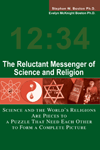
Buy from Amazon.com
The Essential Teachings of Herbert W. Armstrong
His Teachings Focused on The Incredible Human Potential. Did He Solve the Mystery of the Ages?
New Book about HWA's Teachings. Recommended!
.
.
.
.
.
.
.
.
.
.
.
.
.
.
.
.
.
.
.
.
.
.
.
.



Click here for The Reluctant Messenger (Host Site)
The Gospel of Thomas
The Fifth (5th) GospelSecret Sayings of Christ
The Gospel of Thomas is a collection of traditional sayings, prophecies, proverbs, and parables of Jesus. The Coptic Gospel of Thomas was translated from the Greek; in fact, several fragments of this Greek version have been preserved, and can be dated to about 200 C.E. Thus the Greek (or even or Aramaic) collection was composed in the period before about 200 C.E., possibly as early as the second half of the first century, in Syria, Palestine, or Mesopotamia. The authorship of the Gospel of Thomas is attributed to Didymos Judas Thomas, that is, Judas "the Twin," who was an apostle of Jesus.
The relationship of the Gospel of Thomas to the New Testament gospels have been a matter of special interest: many of the sayings of the Gospel of Thomas have parallels in the synoptic gospels (Matthew, Mark, and Luke). A comparison of the sayings in the Gospel of Thomas with their parallels in the synoptic gospels suggests that the sayings in the Gospel of Thomas either are present in a more primitive form or are developments of a more primitive of such sayings. Indeed, the Gospel of Thomas resembles the synoptic sayings source, often called "Q" (from the German word Quelle, "source"), which was the common source of sayings used by Matthew and Luke. Hence, the Gospel of Thomas and its sources are collections of sayings and parables are closely related to the sources of the New Testament gospels. Because of the close parallel between many of the sayings in Thomas and the Gospels, some scholars have suggested that Thomas is also based on the Q source or is actually Q itself. Of course, these remain only hypotheses since there is no conclusive proof that a Q source ever existed. Still, the existence of a collection of sayings of Jesus as early as the dates proposed for Thomas suggests that there did exist such a collection in the early church. Some authorities have referred to this sacred text as the Fifth Gospel (5th Gospel)
The Apostle Thomas was also called Didymus which in the Greek means Twin or Double.
KJV John 11:16 said Thomas, which is called Didymus KJV John 20:24 ..one of the twelve, called Didymus KJV John 21:2 Simon Peter, and Thomas called Didymus
This is from the King James Version, some translations render it the Twin instead of using the Greek Didymus
Revised Standard Version John 11:16 Thomas, called the Twin, said to his fellow disciples, "Let us also go, that we may die with him."
Amplified Bible John 11:16 Then Thomas, who was called the Twin...
The Gnostics called Thomas the Twin Brother of Jesus. It turns out that this is also a metaphor for the soul and spirit. The secret information that is hidden in the Gospel in coded form is how the soul and spirit must become one in a special divine marriage to prevent the second death from occurring. The similies of marriage, female into male, and two into one, are coded messages about the secret to eternal life.
Gospel of Thomas
Scholars Translation
Gospel of Thomas
Paul Halsall
Gospel of Thomas
Translator Nancy Johnson
Gospel of Thomas
Messrs-Brill of Leiden
Original Christianity: A New Key to Understanding the Gospel of Thomas and Other Lost Scriptures

Links
Gospel of Thomas (Research by Stevan Davies.) a New Translation Based On the Inner Meaning Mark's Use of the Gospel of Thomas Mark's Use of the Gospel of Thomas II Gospel of Thomas Translated by Thomas O. Lambdin Gospel of Thomas: Dennis Bratcher Is the Gospel of Thomas Reliable? Why Isn't The Gospel of Thomas Canon? Gospel of Thomas Gnostic Scripture Johannine Sayings in the Gospel of Thomas The Gnostic Apostle Thomas Gospel of Thomas: Nadia Babich and Hang Nguyen THE GOSPEL OF THOMAS, AND THE OTHER GNOSTIC APOCRYPHAL GOSPELS The truth behind the hidden Gospel of Thomas Rehabilitating the Gospel of Thomas What about the Gospel of Thomas? Gospel of Thomas xref NT